Simon's model does not produce Zipf's law: The fundamental rich-get-richer mechanism for any power-law size ranking
Pablo Rosillo-Rodes, Julia Witte Zimmerman, Laurent Hébert-Dufresne, and Peter Sheridan Dodds
Times cited: 1
Abstract:
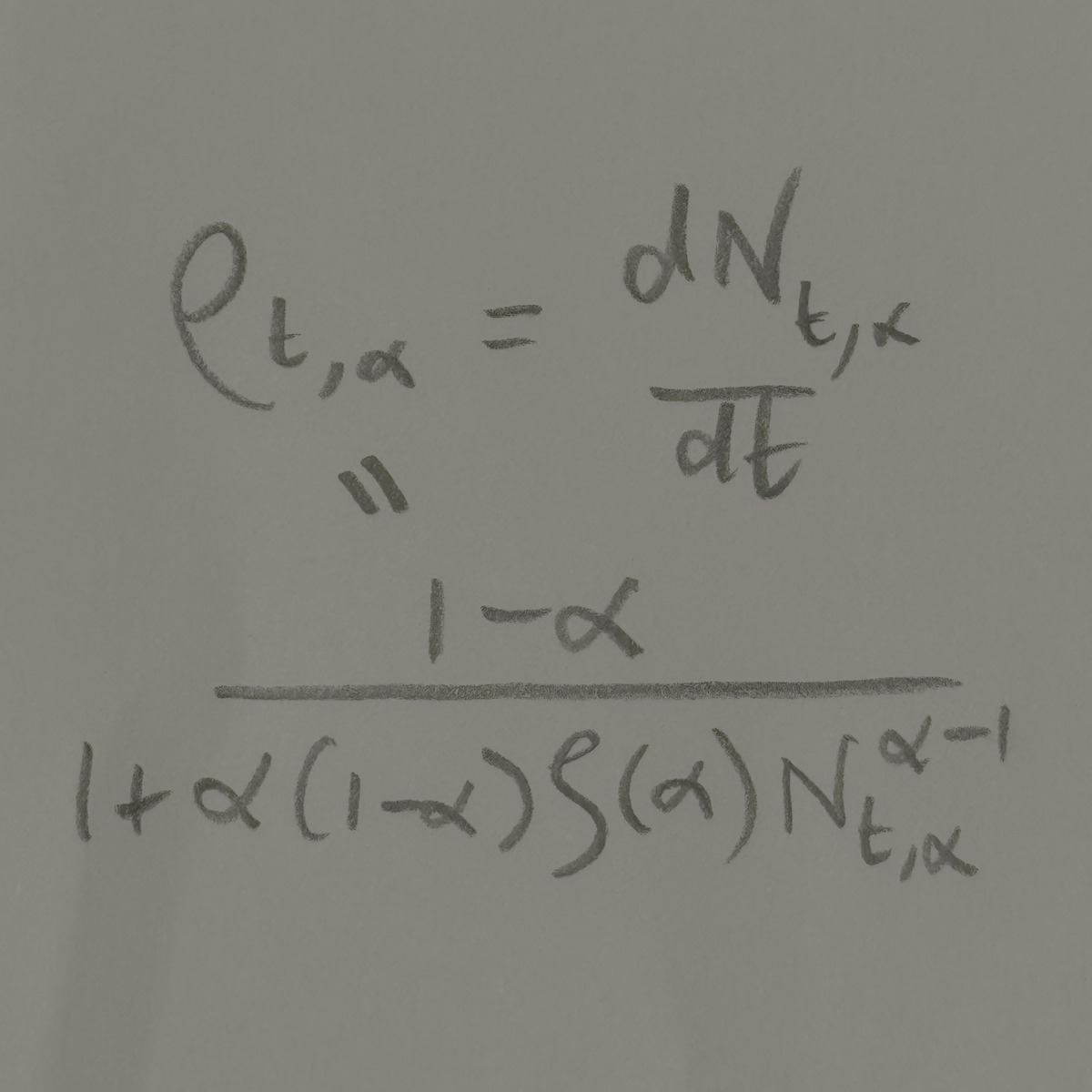
Many complex systems are composed of disparate, interacting types of varying 'sizes': Species abundances in ecosystems, firm sizes in markets, city populations in countries, word counts in language, etc. A longstanding mystery of complex systems is Zipf's law, which is the empirical observation that component size decreases as the inverse of component rank—$S \propto r^{-1}$— and its generalization $S \propto r^{-\alpha}$ for $\alpha \ge 0$. Herbert Simon's 1955 theoretical rich-get-richer mechanism for system growth has prevailed as capturing the essential process. But Simon's analysis is in fact flawed: In the limit of zero innovation, the model leads to a winner-takes-all system with $\alpha \rightarrow \infty$, rather than $\alpha \rightarrow 1$. Here, for pure rich-get-richer systems, we derive the time-dependent innovation rate $\rho_t$ that correctly produces power-law size rankings across all $\alpha \ge 0$. To produce Zipf's law, we uncover that $\rho_t$ must decay as the inverse of the log of the number of types, $1/\ln N$. We then show that our time-dependent innovation rate governs type emergence in any system obeying a power-law size-ranking, independent of the underlying mechanism. We demonstrate agreement between our model's output and word rankings in a collection of famous novels, while Simon's model fails. Going forward, our dynamic innovation rate mechanism provides the fundamental, Drosophila-like model for all rich-get-richer systems.
- This is the default HTML.
- You can replace it with your own.
- Include your own code without the HTML, Head, or Body tags.