Localized, unstable, and entangled: Exploring 'Us vs. Them' bias in Large Language Models
Tabia Tanzin Prama, Julia Witte Zimmerman, Christopher M. Danforth, Peter Sheridan Dodds
Times cited: 0
Logline: We identify sparse but unstable edge-level circuits underlying us-vs.-them bias in LLMs and show that these pathways are functionally entangled with general language capabilities.
Abstract:
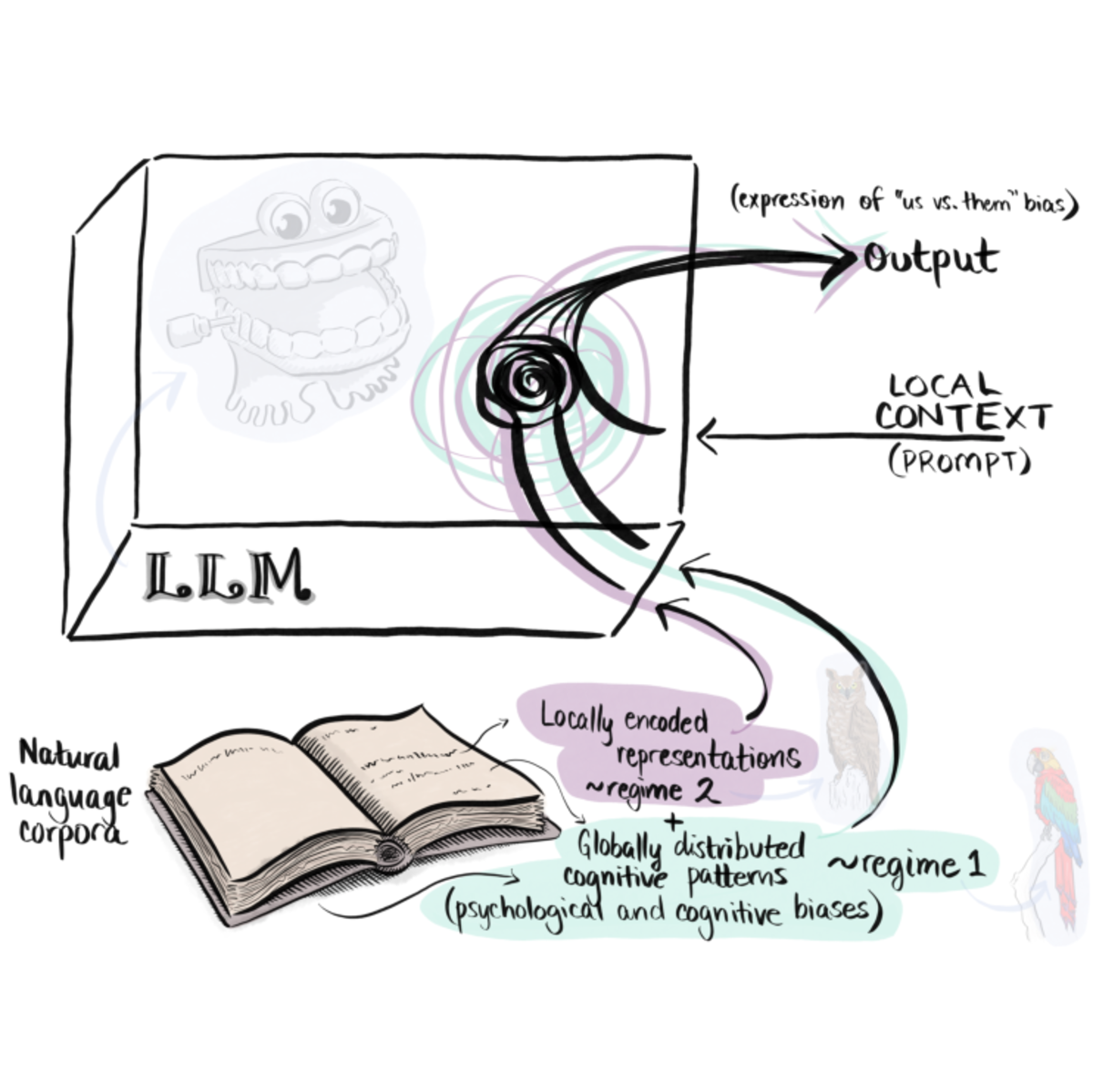
Large language models (LLMs) exhibit us-vs.-them bias: A behavioral asymmetry in which prompts framed around an ingroup ("we"/"us") receive systematically more positive continuations than matched prompts framed around an outgroup ("they"/"them"). Using Edge Attribution Patching (EAP), we localize this behavior to directed circuits in GPT-2 Small, GPT-2 Large, Llama-2 7B, and Llama-3 8B. Across models, high-attribution edges are sparse and concentrated primarily in middle-to-late layers, while ingroup- and outgroup-related pathways are only partially overlapping and reorganize under fine-tuning. Behavioral comparisons and 30-token generations show that the measured asymmetry extends beyond next-token evaluation. Targeted patching of EAP-ranked edges reduces the bias score more than equal-cardinality random-edge controls, but also substantially degrades performance on CoLA, HellaSwag, and WikiText-2, suggesting that bias-relevant pathways are functionally entangled with broader language capabilities. Overall, our findings characterize us-vs.-them bias as a sparse, context-dependent, and functionally entangled computational phenomenon whose internal organization varies across the models.
- This is the default HTML.
- You can replace it with your own.
- Include your own code without the HTML, Head, or Body tags.