Collective sleep and activity patterns of college students from wearable devices
Mikaela Irene Fudolig, Laura S. P. Bloomfield, Matthew Price, Yoshi M. Bird, Johanna E. Hidalgo, Julia N. Kim, Jordan Llorin, Juniper Lovato, Ellen W. McGinnis, Ryan S. McGinnis, Taylor H. Ricketts, Kathryn Stanton, Peter Sheridan Dodds, and Christopher M. Danforth
npj Complexity, 2, 32, 2025
Times cited: 6
Abstract:
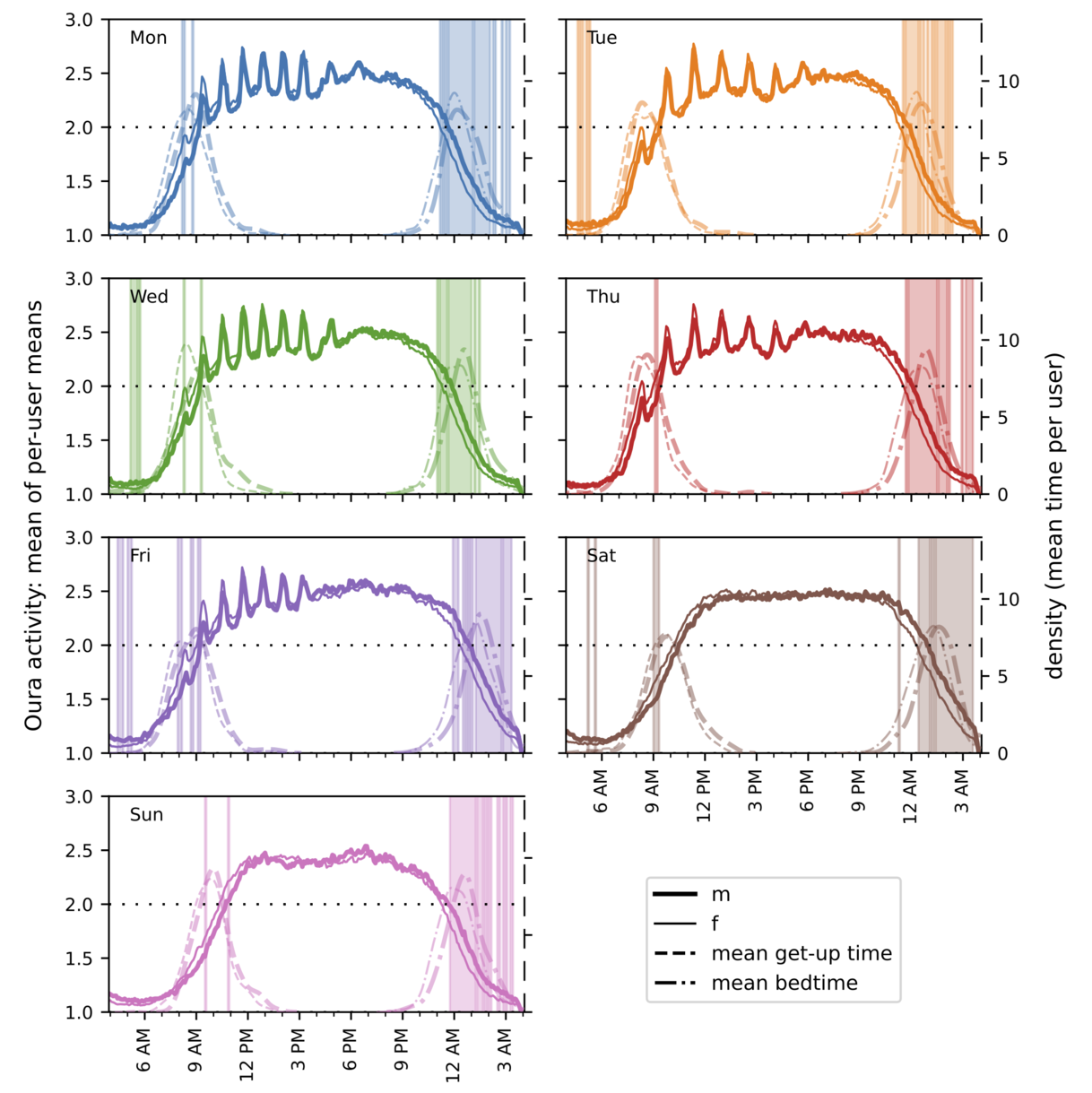
To optimize interventions for improving wellness, it is essential to understand habits that wearable devices can measure with greater precision. Using high temporal resolution biometric data taken from the Oura Gen3 ring, we examine daily and weekly sleep and activity patterns of a cohort of young adults ($N$=582) in their first semester of college. A high compliance rate is observed for both daily and nightly wear, with slight dips in wear compliance observed shortly after waking up and also in the evening. Most students have a late-night chronotype with a median midpoint of sleep at 5 AM; males and those reporting mental health impairment show even more delayed sleep periods. Social jetlag—differences in sleep timing between school days and free days—is prevalent in our sample. While sleep periods generally shift earlier on weekdays and later on weekends, sleep durations during school days and weekends are shorter than during prolonged school breaks, suggesting chronic sleep debt during the academic term. Synchronized spikes in activity aligning with class schedules are also observed, suggesting that walking between classes is a common and substantial contributor to overall activity levels among the students. Lower active calorie expenditure is associated with weekends and a delayed but longer sleep period the night before, suggesting that in this cohort, active calorie expenditure is affected less by deviations from natural circadian rhythms and more by the timing associated with activities. Our findings demonstrate how externally imposed constraints in the academic environment give rise to coordinated patterns in sleep and activity. These dynamics highlight how institutional structures, such as class schedules and campus infrastructure, may be leveraged to influence student well-being.
- This is the default HTML.
- You can replace it with your own.
- Include your own code without the HTML, Head, or Body tags.