Ousiometrics: The essence of meaning aligns with a power-danger-structure framework instead of valence-arousal-dominance
P. S. Dodds, T. Alshaabi, M. I. Fudolig, J. W. Zimmerman, J. Lovato, S. Beaulieu, J. R. Minot, M. V. Arnold, A. J. Reagan, and C. M. Danforth
Science Advances, 12, eadr4039, 2026
Times cited: 0
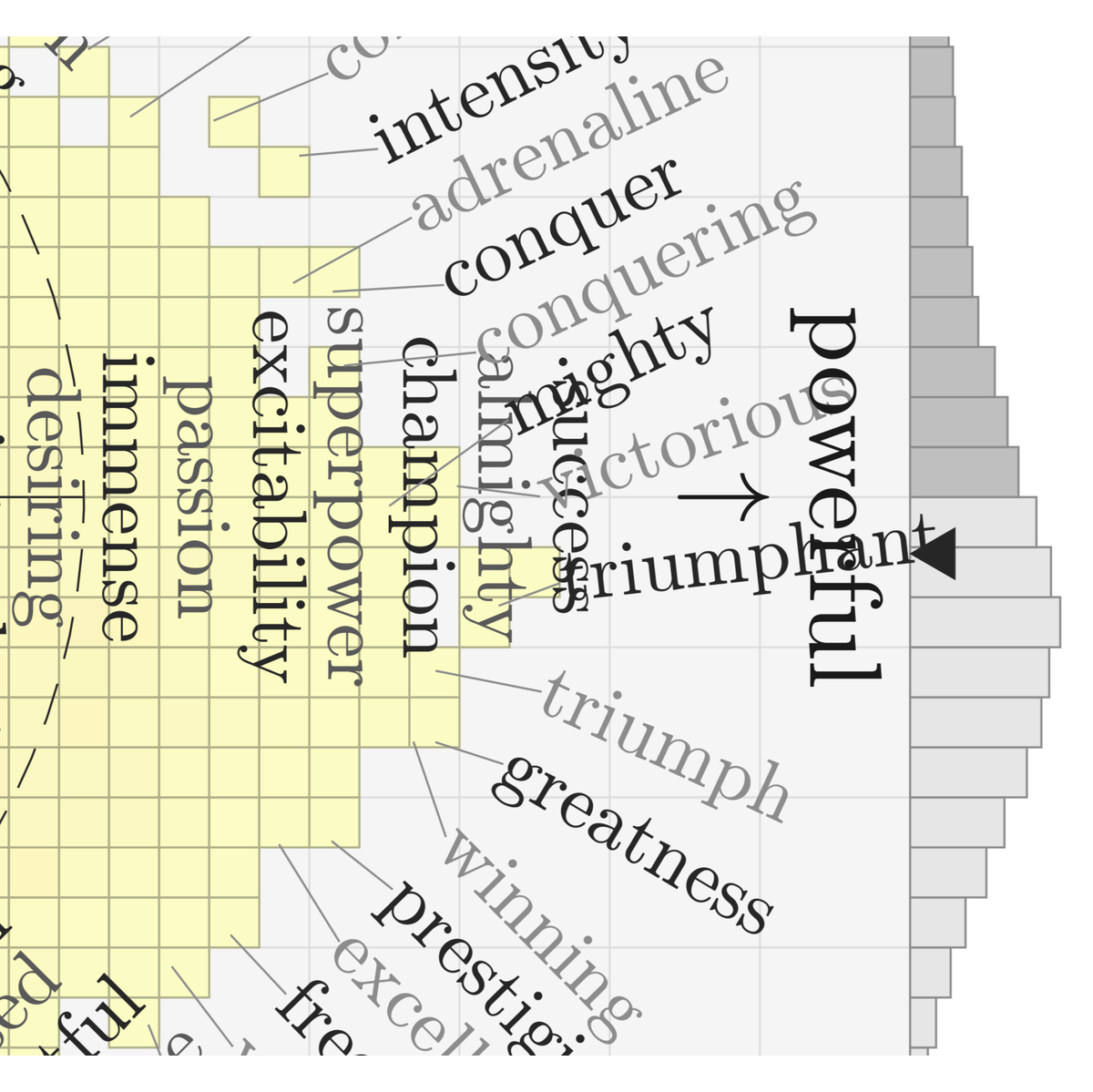
Logline: We show that the essential meaning conveyed by individual words is best represented by a compass-like plane described by interrelated differentials of bad-good, weak-powerful, gentle-aggressive, and safe- joined with a third dimension of structured-unstructured (GPADS). We uncover a linguistic 'safety bias' by examining how words are used in large-scale, diverse corpora. We find the power-danger-structure framework to be naturally aligned with token usage in real corpora as well as with seemingly disparate frameworks. We construct and demonstrate the use of an 'ousiometer' for measuring time series of essential meaning.
Abstract:
From work emerging through the middle of the 20th century, the essence of meaning has become widely accepted as being described by the three orthogonal dimensions of valence, arousal, and dominance (VAD). These essential dimensions have become the cornerstone of sentiment analysis across many fields. By re-examining first types and then tokens for the English language, and through the use of automatically annotated histograms—'ousiograms'—we find here that: The essence of meaning conveyed by words is instead best described by a goodness-power-aggression-danger-structure circumplex framework (GPADS); that large-scale English language corpora reveal a systematic bias toward safe, low-danger words; and that the power-danger-structure (PDS) framework is the minimal framework that represents essential meaning. We find remarkable congruences between the GPADS framework and other spaces including mental states and fictional archetypes, and we construct and demonstrate a prototype ousiometer.
- This is the default HTML.
- You can replace it with your own.
- Include your own code without the HTML, Head, or Body tags.