Predictors of anxiety trajectories in cohort of first-year college students
L. S. P. Bloomfield, M. Fudolig, P. S. Dodds, J. Kim, J. Llorin, J. Lovato, E. McGinnis, R. McGinnis, M. Price, T. Ricketts, K. Stanton, C. M. Danforth
JAACAP Open, 2024
Times cited: 22
Abstract:
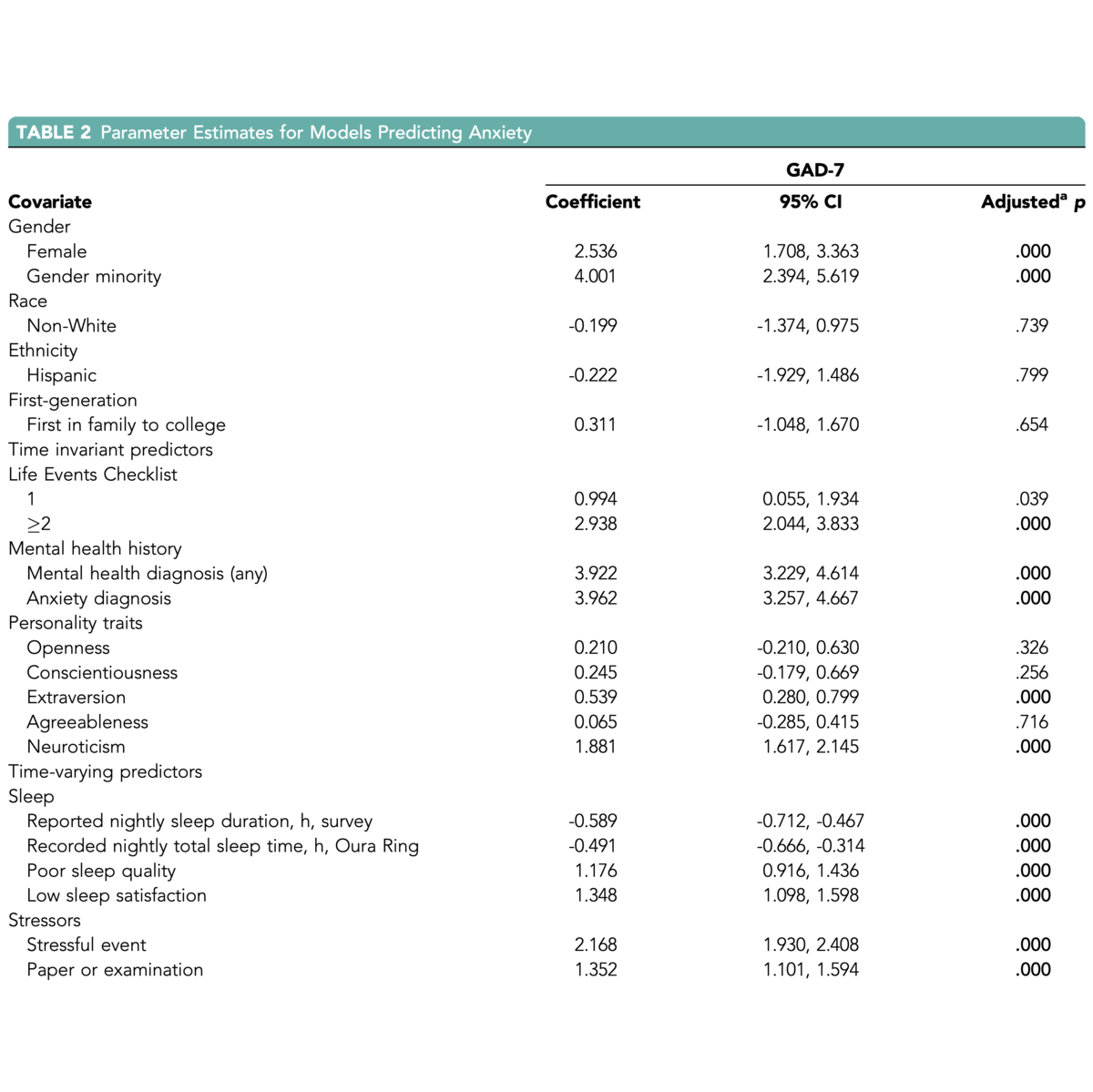
\textbf{Objective:} The transition to college is a period of growth and vulnerability for young adult health and well-being and provides a critical window for potential behavioral interventions. In this study, we sought to examine the trajectory of anxiety symptoms and their association with individual characteristics, exposure to stressors, and sleep behaviors during the transition to college. \textbf{Method:} We recruited full-time, incoming undergraduate students at a university in the northeastern United States to participate during the first semester of college between October 21, 2022, and December 12, 2022. In a longitudinal cohort study (N = 556), we collected baseline demographic and health history information and weekly survey assessments with the outcome measure of anxiety. Predictors included weekly stressors and sleep measures during this period. Mixed-effects linear models were used to examine trajectories in anxiety symptoms during the first semester of college. \textbf{Results:} We had 6 main findings. First, there were significantly higher anxiety symptoms in non-male participants compared to male participants. Second, a previous mental health diagnosis and previous traumatic exposures were significant predictors of anxiety symptoms. Third, the personality traits of extraversion and neuroticism were significant predictors of anxiety symptoms. Fourth, perceived sleep duration, quality, and satisfaction were significant predictors of anxiety symptoms. Fifth, sleep duration estimates collected by a biometric wearable were also a significant predictor of anxiety in covariate-adjusted, corrected models. Sixth, weekly stressors and specifically academic stressors were significant predictors of anxiety symptoms. \textbf{Conclusion:} Programs that support young adults entering college may promote sleep hygiene behaviors and target times of particularly elevated stress such as examination periods.
- This is the default HTML.
- You can replace it with your own.
- Include your own code without the HTML, Head, or Body tags.