

Divergent discourse between protests and counter-protests: #BlackLivesMatter and #AllLivesMatter
R. J. Gallagher, A. J. Reagan, C. M. Danforth, and P. S. Dodds
Times cited: 2
Abstract:
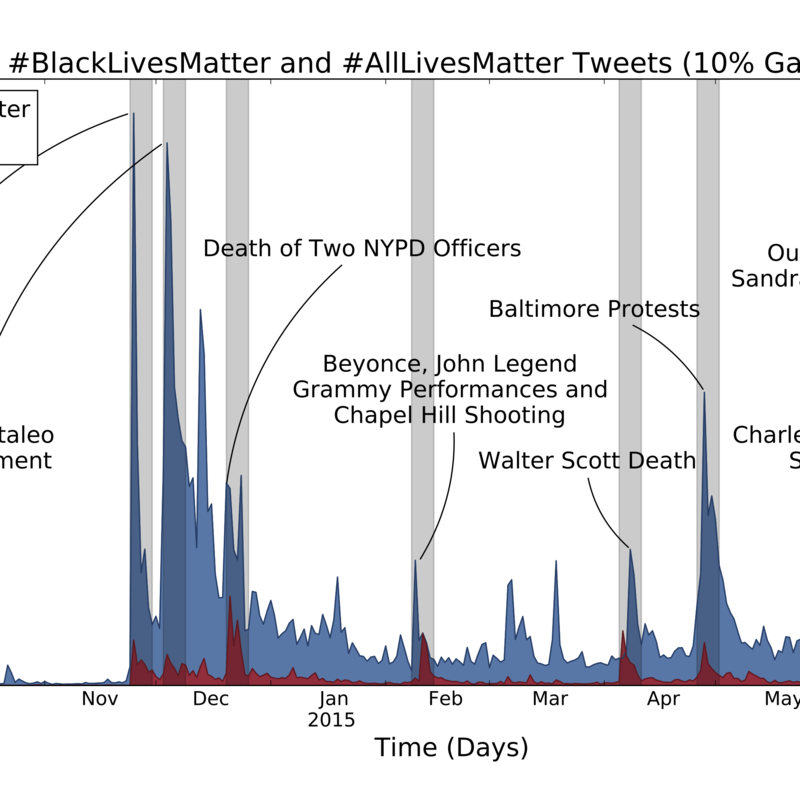
Since the shooting of Black teenager Michael Brown by White police officer Darren Wilson in Ferguson, Missouri, the protest hashtag #BlackLivesMatter has amplified critiques of extrajudicial killings of Black Americans. In response to #BlackLivesMatter, other Twitter users have adopted #AllLivesMatter, a counter-protest hashtag whose content argues that equal attention should be given to all lives regardless of race. Through a multi-level analysis, we study how these protests and counter-protests diverge by quantifying aspects of their discourse. In particular, we introduce methodology that not only quantifies these divergences, but also reveals whether they are from widespread discussion or a few popular retweets within these groups. We find that #BlackLivesMatter exhibits many informationally rich conversations, while those within #AllLivesMatter are more muted and susceptible to hijacking. We also show that the discussion within #BlackLivesMatter is more likely to center around the deaths of Black Americans, while that of #AllLivesMatter is more likely to sympathize with the lives of police officers and express politically conservative views.
- This is the default HTML.
- You can replace it with your own.
- Include your own code without the HTML, Head, or Body tags.
BibTeX:
@Misc{gallagher2016a,
  author =	 {Gallagher, Ryan J. and Reagan, Andrew J. and
                  Danforth, Christopher M. and Dodds, Peter Sheridan},
  title =	 {Divergent discourse between protests and
                  counter-protests: \#BlackLivesMatter and
                  \#AllLivesMatter},
  year =	 {2016},
  note =	 {Available at \href{http://arxiv.org/abs/1606.06820}{http://arxiv.org/abs/1606.06820}},
}